

House of Representatives
Government Inefficiency in Combating Organized Crime and Its Classification as Terrorism.
Simulation Model: Members of Congress
About the Topic
Brazil faces a chronic public safety crisis, evidenced by the rise and complex organization of major criminal factions. This situation did not arise overnight; it is a direct reflection of historical failures. Deep socioeconomic inequality, the absence of basic public policies in vulnerable areas, overcrowding and lack of control in the prison system, as well as intelligence and logistical failures at the borders, have created a vacuum. It was precisely in this space of inefficiency and absence of the State that organized crime found fertile ground to expand, dominate territories, and establish a parallel power structure.
Faced with the urgency of regaining control and combating this structured threat, a polarizing proposal is gaining momentum in the legislative arena: amending the law to classify the actions of these criminal organizations directly as acts of terrorism.
It is at this point that the ideological and political clash takes shape. Presented as a solution, the measure divides opinions and demands a thorough analysis. On one side of the debate, it is argued that extreme criminal severity and classification as terrorism are the only proportionate responses to groups that threaten national sovereignty and peace. On the other, it is questioned whether this classification is not merely a punitive smokescreen that masks the true roots of the problem, running the risk of generating even more disproportionate incarceration without, in fact, resolving the social and structural deficit
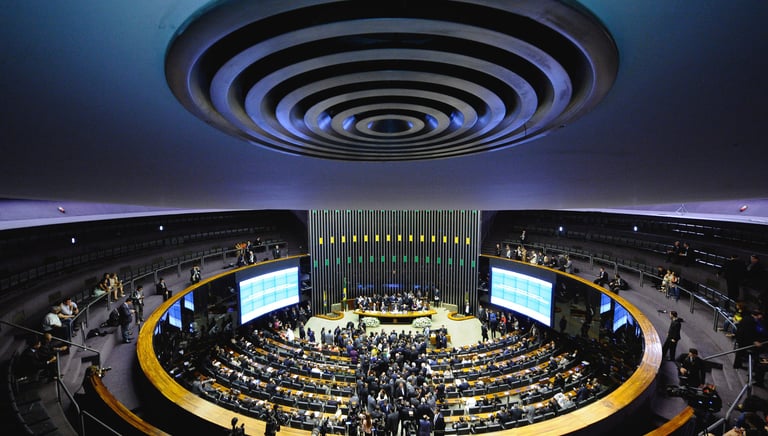


Your role as a Member of Congress
As a member of Congress in this simulation, your main challenge is to set aside your personal convictions and faithfully embody the guidelines, ideology, and interests of your constituents and your political party. In the Chamber of Deputies, a diversity of ideas is the name of the game.
The debate over classifying organized crime as terrorism divides opinion. Depending on your political stance, your role will take on very different forms. You may represent a caucus focused on strict criminal justice, advocating for tougher laws as the only viable response to the security crisis. On the other hand, your mandate may be aligned with the defense of human rights, focusing on the structural roots of crime and warning of the risks of a punitive state and mass incarceration.
Your mission will be to legislate, forge alliances, propose amendments, and debate with excellence. You will need to use your public speaking and negotiation skills to convince your peers, build consensus, and pass bills that reflect your caucus’s vision of how Brazil should address state inefficiency in public safety.


Esther Bryce
Founder / Interior designer


Lianne Wilson
Broker


Jaden Smith
Architect


Jessica Kim
Photographer